June 9, 2026 · 3 min read
If you have ever taken a Reformer Pilates class, you have surely heard your instructor remind you: “Inhale… exhale…”. It’s not a detail. For Joseph Pilates, breathing was the foundation of the whole method. Breathing well makes every exercise more effective, protects the back and calms the mind. Here is how to master it.
Why is breathing so important in Pilates?
Breathing directly influences the deep muscles of the trunk. The diaphragm, the main breathing muscle, works as a team with the transverse abdominis, the pelvic floor and the deep back muscles. When you breathe in coordination with movement, these muscles activate at the right moment and stabilize the spine.
Breathing also affects the nervous system. Slow, deep breathing activates the body’s relaxation response, reduces muscle tension and supports concentration. That’s why you often leave a Pilates class feeling both energized and calm.
Lateral thoracic breathing
In Pilates, we mainly practice lateral breathing: on the inhale, the ribs expand sideways and toward the back, like an accordion, rather than puffing out the belly. This technique keeps the deep abdominals gently engaged while you breathe fully.
To feel it, place your hands on each side of your ribs. Inhale through your nose, directing the air into your hands without lifting your shoulders. Then exhale slowly through your mouth, letting the ribs close and the navel gently draw toward the spine.
When to inhale, when to exhale?
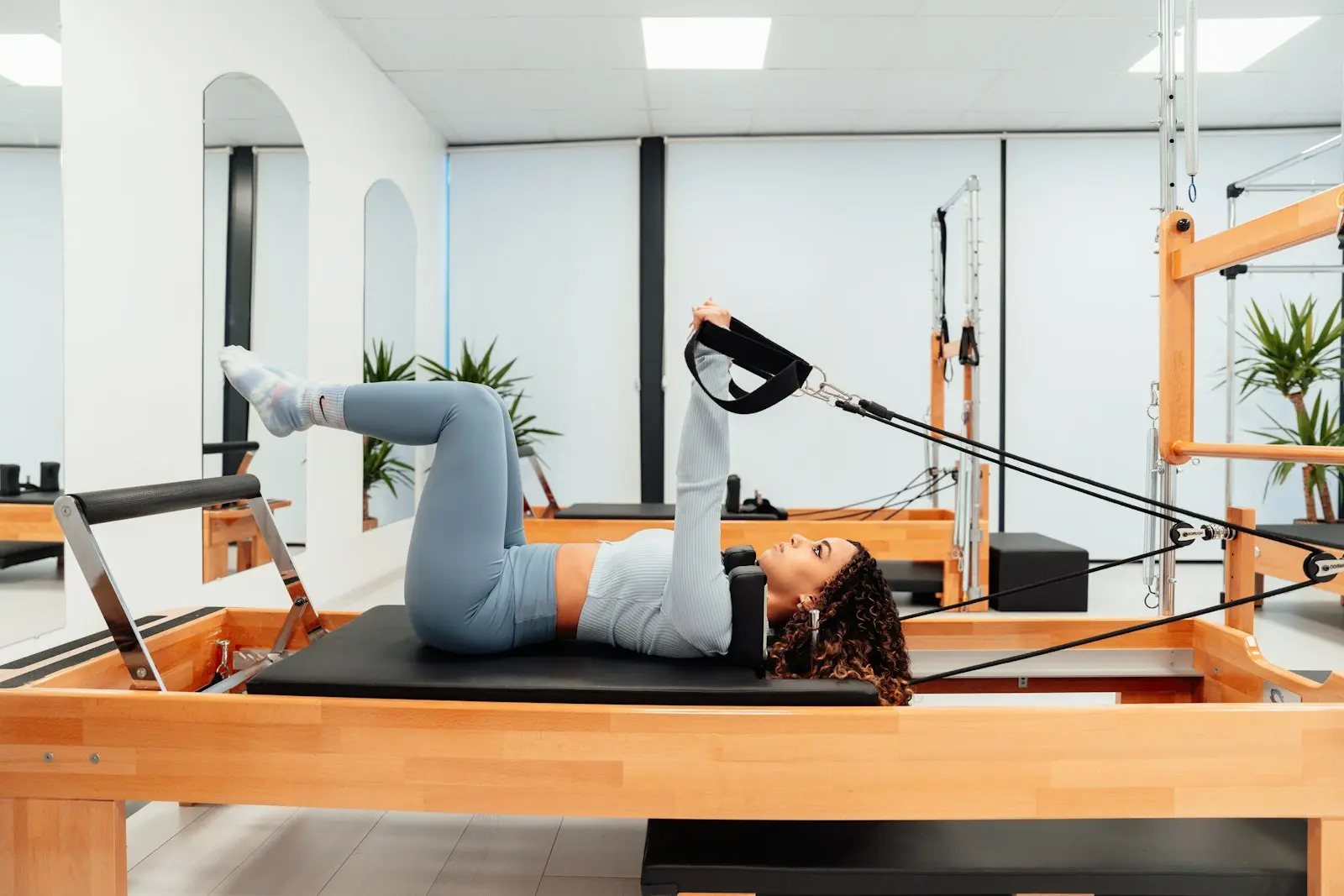
The general rule in Reformer Pilates: exhale during the main effort and inhale during the preparation or return phase. For example, during footwork, you exhale as you push the carriage and inhale as you come back. The active exhale helps engage the core exactly when the body needs it most.
Your instructor will guide you, since some exercises follow a different rhythm. Over time, breathing becomes natural and sets the pace for the whole class.
The most common mistakes
- Holding your breath during effort, which unnecessarily increases tension and pressure.
- Breathing by lifting the shoulders, which creates neck tension.
- Fully puffing out the belly and losing core engagement.
- Breathing too fast, which keeps the movement from staying fluid and controlled.
An exercise to do at home
Lie on your back, knees bent, feet on the floor. Place your hands on your ribs. Inhale for four counts, opening the ribs, then exhale for six counts, feeling the core engage. Repeat ten times. This simple exercise improves breathing awareness and is perfect preparation for your Reformer Pilates classes.
Breathing beyond the studio
The breathing you learn in Pilates is a valuable tool in daily life: before an important meeting, in traffic or at night to sleep better. A few slow breaths are often enough to bring tension down. We explore this link between Pilates and mental wellbeing in our article on Pilates, stress and mental health.
Breathing is also reconnecting
At BLVD Pilates, every class starts with a few conscious breaths. This moment lets you leave the day behind, come back into your body and prepare for movement. It’s an essential part of the experience we want to offer, and of our vision of wellness, which you can discover on the About page.
Putting theory into practice
The best way to learn Pilates breathing is to practice it with an instructor who guides and corrects you. Book your Reformer Pilates class at the studio in Laval and discover how much good breathing transforms every movement.
Ready to try?
Experience Reformer Pilates in Laval
Book your class at the BLVD Pilates studio in Chomedey and feel the difference from the very first session.